
Story & Lineage
Mestre Cafu
“Capoeira is like life — when the rhythm changes, so must the way you play.”
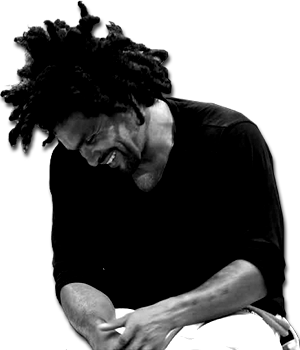
Born and raised in Brazil, Mestre Cafu began practicing Capoeira at age six and was teaching by fifteen. He helped establish the Capoeira groups Roots of Brazil, ABADA Capoeira, and Gingado Capoeira. For 30+ years he has taught Capoeira and Brazilian Jiu-Jitsu across the U.S.
“My mission is to make a change in the way that I have seen Capoeira being taught. I take the time to correct my students and push them in a positive way. I demand that my students take pride in the game that they play so that they will represent the group well. I believe in staying true to the roots that my ancestors fought for.”
A lineage to the source
Cafu's Capoeira lineage runs to the source. In 1999 he was graduated to Mestre by three original students of the legendary Mestre Bimba — Mestre Pombo de Ouro, Mestre Onça Tigre, and Jota Bamberg (Mestre Angoleiro) — placing him directly in the Capoeira Regional tradition Bimba founded. He helped establish Roots of Brazil and ABADA Capoeira, pioneered Capoeira in Hawaii, and has taught across California, Colorado, Hawaii, and Texas for 30+ years.
What we stand for
The History of Capoeira
In the Beginning
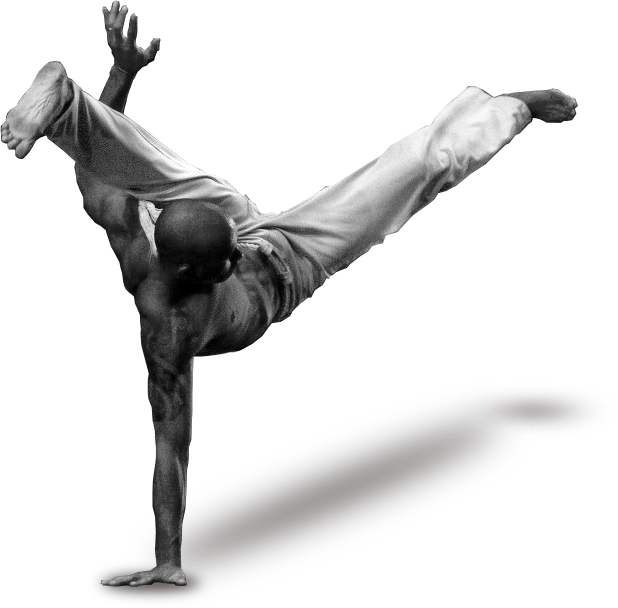
The art of Capoeira was born over 400 years ago in Brazil as a martial art combining traditional African elements of music and dance. The African slaves of Brazil developed it as a means of survival and freedom. It is estimated that over 2 million slaves were brought from different regions of Africa to Brazil, dispersed into three ports — Bahia, Recife and Rio de Janeiro. Organization amongst the slaves was difficult because many were from enemy tribes. They began to run away to escape the oppression of slavery, fleeing into the jungles and forming secret societies known as Quilombos. Here, the African tribes were able to put their differences aside and unite to fight for a common interest: FREEDOM.
They developed a fighting technique — 'jungle war,' or ambush — in which Capoeira was the key element in staging unexpected revolts. They helped free other slaves and disrupt the plantations. Seen as a threat, Capoeira became outlawed and punishable by death. They were only able to maintain their martial art by disguising it as a folk-dance. Their clever tactic of hiding self-defense movements within song and dance proved effective. While it looked like a celebration, the slaves were really planning their liberation.
The Masters Who Preserved It
There are two notable pioneers of Capoeira — Mestre Bimba and Mestre Pastinha — who preserved the art. Both practiced the original style of Capoeira Angola, the slower game played close to the ground. Mestre Bimba began combining elements of Capoeira Angola and Batuque (a dance his father championed), developing his flow from it. Tired of seeing people play only close to the ground, he created his own faster style: Capoeira Regional.
Capoeira gained the attention of influential politicians. On June 23, 1953, Mestre Bimba was invited by President Getúlio Vargas to perform at Palácio da Aclamação. The performance was a ground-breaking success that led to the legalization of Capoeira — the president declaring it an authentic Brazilian contribution to physical education, and that it should be considered a national sport of Brazil.